





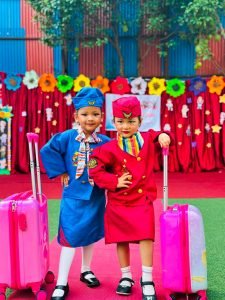
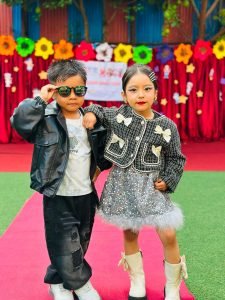
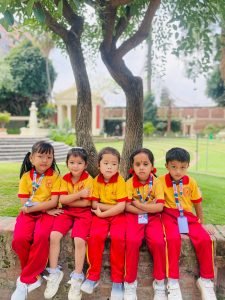
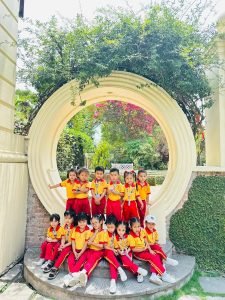
Lower Kindergarten (LKG)
Lower Kindergarten (LKG) builds upon the foundational skills developed in Nursery and gradually introduces children to a more structured and purposeful learning environment. At this stage, children become more confident learners as they strengthen their language, communication, cognitive, and social skills through a balanced combination of guided instruction and play-based learning.
Our LKG program is designed to encourage curiosity, independent thinking, and active participation. Teachers use child-friendly and engaging teaching methods such as storytelling, phonics-based activities, educational games, hands-on learning experiences, music, and creative projects to make learning enjoyable and meaningful. The classroom environment promotes exploration, collaboration, and self-confidence while preparing children for the academic expectations of Upper Kindergarten.
Key learning areas include:
Alphabet Writing and Phonetic Awareness: Children learn to write both uppercase and lowercase letters correctly while developing an understanding of letter sounds through systematic phonics instruction. Activities focus on letter formation, sound recognition, blending, and identifying beginning and ending sounds to build a strong literacy foundation.
Basic Reading and Word Recognition: Through phonics, picture books, flashcards, and interactive reading sessions, children begin reading simple words and sentences. They develop sight vocabulary, improve pronunciation, strengthen comprehension skills, and gain confidence in early reading.
Counting and Number Concepts: Children enhance their mathematical understanding by learning number recognition, counting, number sequencing, simple addition and subtraction, comparison of quantities, shapes, patterns, and measurement through fun, hands-on activities and educational games.
Environmental Awareness and Observation: Young learners explore the world around them by learning about plants, animals, weather, seasons, family, community helpers, transport, healthy habits, and nature. Observation-based activities encourage curiosity, questioning, and an appreciation for their surroundings.
Art, Music, and Creative Expression: Creative activities such as drawing, painting, coloring, craft work, singing, dancing, and dramatic play encourage imagination and self-expression. These experiences help children develop creativity, confidence, emotional expression, and an appreciation for the arts.
Development of Fine Motor and Coordination Skills: Children participate in activities such as tracing, cutting, threading, folding, clay modeling, puzzles, and building blocks to strengthen finger muscles, hand-eye coordination, concentration, and the fine motor skills required for writing and other daily tasks.
Communication and Social Development: Classroom discussions, group activities, role-play, and collaborative games help children improve their speaking, listening, and interpersonal skills. They learn important values such as sharing, cooperation, empathy, respect, responsibility, and teamwork while building meaningful friendships.
Physical Development and Independence: Indoor and outdoor play, movement exercises, and physical activities promote balance, coordination, strength, and overall well-being. Children also develop independence by learning classroom routines, organizing their belongings, following instructions, and taking responsibility for simple daily tasks.
Our LKG program provides a joyful, stimulating, and supportive learning environment where children develop the confidence, knowledge, and essential skills needed for future academic success. By nurturing curiosity, creativity, and a love for learning, we help every child grow into an enthusiastic and capable learner.